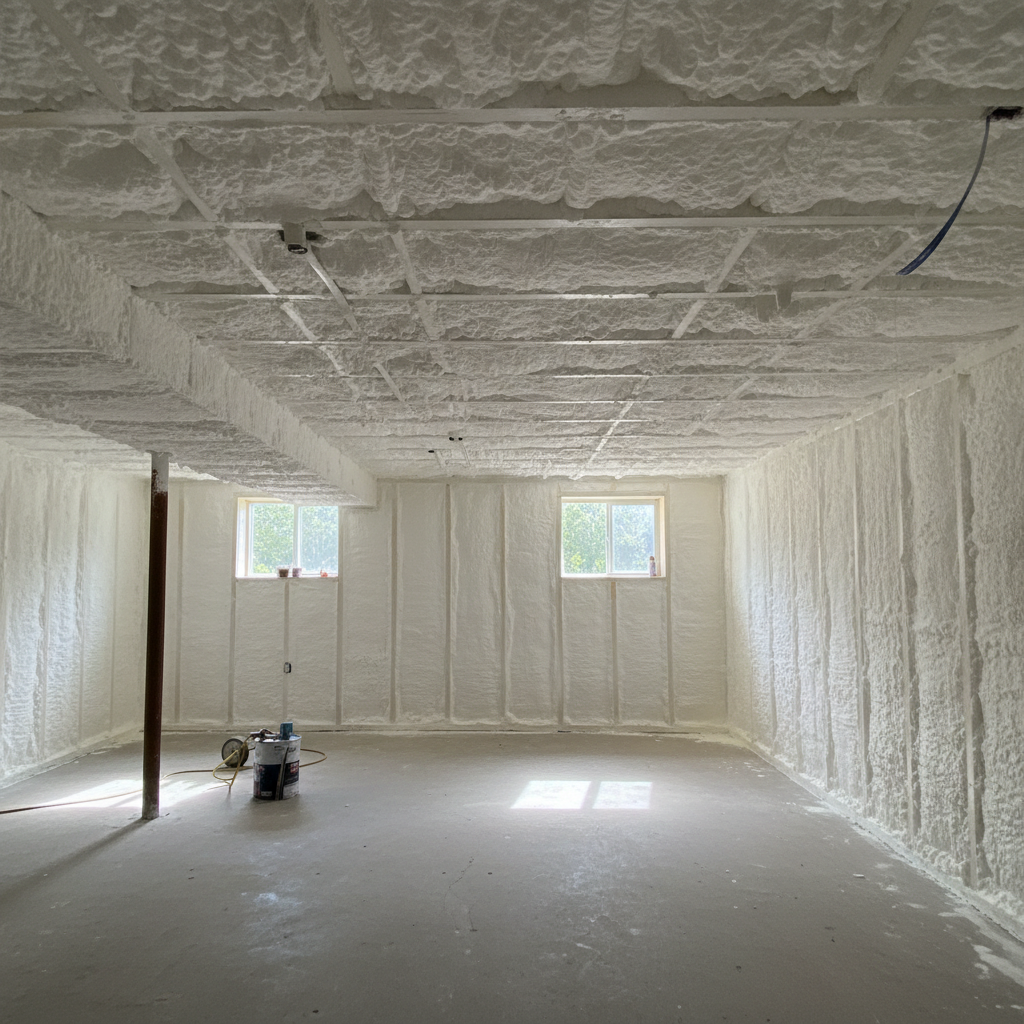
Alright, let's talk about insulating your basement. Maybe you've got a finished basement that's always chilly, or you're planning to finish one out and want to do it right from the start. Whatever the reason, you're probably wondering what this project is going to set you back. I've been doing this a long time here in New Braunfels, and I can tell you, it's not a one-size-fits-all answer. But I can give you a pretty good idea of what to expect.
What Makes Basement Insulation Prices Jump Around?
A few things really push the price up or down. It's not just about the square footage, though that's a big part of it. Here's what I look at when I'm putting a quote together:
- Type of Insulation: This is probably the biggest factor. Are we talking about fiberglass batts, mineral wool, or spray foam? Each has its own cost and how well it performs. Spray foam, especially closed-cell, usually costs the most per square foot, but it gives you better R-value and moisture resistance. That can be a big deal here in our humid Texas climate.
- Basement Type and Condition: Is it a full basement, a walk-out, or just a small cellar? Are the walls already framed, or do we need to work around exposed foundation walls? Any existing insulation that needs to be pulled out? All these things add time and labor, you know?
- Accessibility: Can my crew easily get to the areas that need insulating? If we're crawling through tight spaces, working around ductwork, or dealing with a lot of obstructions, that takes more time and skill. And that'll show up in the labor cost.
- R-Value Requirements: The higher the R-value you need (meaning more insulation), the more material we'll use, and that adds to the cost.
- Local Labor Rates: This varies a bit, but generally, skilled insulation installers aren't cheap. You're paying for expertise and efficiency.
Typical Cost Ranges for Basement Insulation in New Braunfels
Okay, let's get down to some numbers. Keep in mind these are averages, and your specific project could be higher or lower. For a typical New Braunfels basement, say 800 to 1,200 square feet of wall space, here's a ballpark:
- Fiberglass Batts (R-13 to R-19): This is usually the cheapest option. You're probably looking at around $1.00 to $2.00 per square foot for materials and installation. So, for that 1,000 sq ft basement, it could be $1,000 to $2,000. It's good for thermal resistance but doesn't do much for air sealing.
- Mineral Wool Batts (R-15 to R-23): A step up from fiberglass, mineral wool offers better fire resistance and sound dampening. Expect to pay $1.50 to $2.75 per square foot installed. For our 1,000 sq ft example, that's $1,500 to $2,750.
- Open-Cell Spray Foam (R-3.5 to R-3.7 per inch): This is a fantastic option for air sealing and thermal performance. It fills every crack and crevice. You'll typically see prices from $1.75 to $3.00 per board foot (a board foot is one square foot, one inch thick). So, if you're doing 4 inches thick, you're looking at $7.00 to $12.00 per square foot of wall area. For a 1,000 sq ft basement, that's $7,000 to $12,000. Yeah, it's a jump, but the performance is night and day.
- Closed-Cell Spray Foam (R-6 to R-7 per inch): The Cadillac of insulation. It's dense, acts as a vapor barrier, and provides structural rigidity. Costs are usually $2.50 to $4.00 per board foot. At 2 inches thick, that's $5.00 to $8.00 per square foot of wall. For 1,000 sq ft, you're in the $5,000 to $8,000 range. You might use this where space is really tight but you need maximum R-value, or if you're worried about moisture from the outside.
Remember, these are just for the insulation itself. If you need framing, drywall, or other finish work, that's a whole separate project.
What Should Be Included in Your Quote?
When you get a quote from Summit Insulation Inc, or any reputable company, it should be clear and itemized. Here's what you should expect to see:
- Material Costs: The type and quantity of insulation, clearly specified.
- Labor Costs: This covers the crew's time, expertise, and any specialized equipment.
- Prep Work: Any necessary masking, sealing, or protection of surrounding areas.
- Cleanup: Hauling away any debris or waste.
- Warranty Information: What kind of guarantee do they offer on their work?
- Permits (if applicable): Sometimes, especially with spray foam, permits are required. Make sure this is addressed.
What you don't want is a vague, one-line quote. If it's not detailed, ask questions until you understand every line item.
Don't Overpay: How to Get a Fair Deal
Nobody wants to get ripped off, especially when you're investing in your home. Here's my advice:
- Get Multiple Quotes: This is a no-brainer. Talk to at least three different companies. It helps you compare not just prices, but also their approach and professionalism.
- Ask for References: A good contractor will be happy to provide them. Call those folks and ask about their experience.
- Check Licenses and Insurance: Make sure they're properly licensed and insured. You don't want any liability falling back on you if something goes wrong.
- Understand the R-Value: Don't just compare prices; compare the R-value you're getting for that price. A cheaper quote might be using less effective insulation.
- Don't Rush: Take your time to review the quotes and ask all your questions. A high-pressure sales tactic is a red flag.
- Look for Local Expertise: Someone who knows New Braunfels, knows our clay soils and how that affects foundations, and understands our hot, humid summers and occasional freezes, is going to give you better advice than an out-of-towner.
Insulating your basement is a smart investment. It'll make your home more comfortable, save you money on energy bills, and can even prevent moisture issues down the road. Just do your homework, ask the right questions, and you'll get a great result without breaking the bank.